
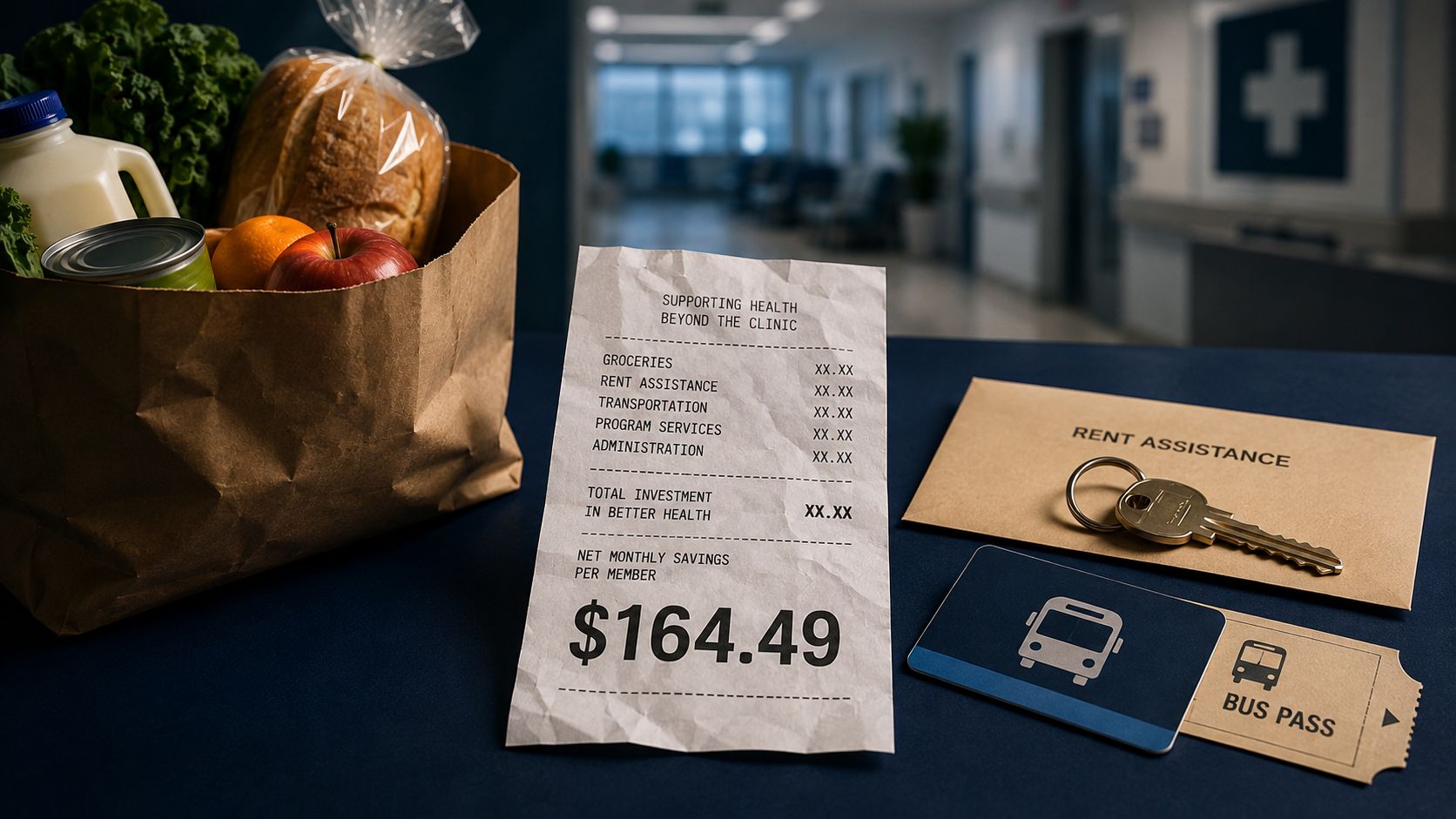
One hundred sixty four dollars. That is what North Carolina Medicaid saved every month, on every person enrolled in the Healthy Opportunities Pilots, after paying for the groceries, the rent assistance, the bus fare, and the staff who ran the whole thing. For close to two decades, healthcare executives have stood on stages and promised to treat the whole patient. Then they killed the budget line the second a finance leader asked what it returned. A state legislature just answered the return question in public, in a purple state, with a peer-reviewed evaluation and a line item, and the industry keeps asking for a business case that already exists.
The Cecil G. Sheps Center for Health Services Research at UNC ran the summative evaluation. More than 31,000 enrollees. Services ran from March 15, 2022 through November 30, 2024. Across a 32-month follow-up, the pilots produced $164.49 less spending per member per month. That interval clears zero, which means the finding holds up statistically. It also counts everything: medical care spending, the cost of every pilot service delivered, and the administrative overhead to run the program. An earlier UNC estimate put annual savings closer to $1,000 per person. The final number lands near $1,968.
Now the political record. CMS approved the waiver in 2018 under a Democratic governor, a Republican state legislature, and the first Trump administration. The General Assembly let the funding lapse in July 2025 and the program went dark for roughly a year. Then, in the budget that passed at the start of July 2026, legislators appropriated $25 million in nonrecurring funds to restart it.
CMS closed the comment period on August 17 for the proposed rule that makes the Medicare Drug Price Negotiation Program permanent. The docket drew 11,408 comments. Biopharma trade groups filed, oncology groups filed, hospital systems filed, and patient organizations showed up thin. A handful filed and filed well. Most did not file at all. A comment letter costs staff time and a deadline. Advocacy organizations skip the cheapest leverage in health policy, then act surprised when the final rule treats patients as a rounding error.
Pull your own nonadherence data and sort it by drive time to site of care.
File in the next relevant docket. A comment letter costs staff time and buys standing that no amount of litigation recovers later.
Tell Congress to codify a permanent pathway for states to integrate evidence-based social services into Medicaid.
Originally published in The Archo Advocate Brief.